Assistance
Consultation
Services
Opinion
Care Coordination
What will your treatment cost?
Kidney Stones: Causes, Symptoms, Types, Treatment and Cost in India
Released Date: 2026-10-08
Kidney stones are one of the most common problems seen by urologists, and they can cause some of the most severe pain a person can experience. They are especially common in hot, dry regions such as the Middle East, North Africa and parts of South Asia - an area often called the "stone belt" - where people lose a lot of fluid through sweating and may not drink enough water. The good news is that almost all kidney stones can now be treated with minimally invasive techniques, often without any cut on the skin, and most patients go home within one or two days. India's leading hospitals offer the latest laser technology for stone removal at a fraction of the cost in Western and Gulf countries.
What are Kidney Stones?
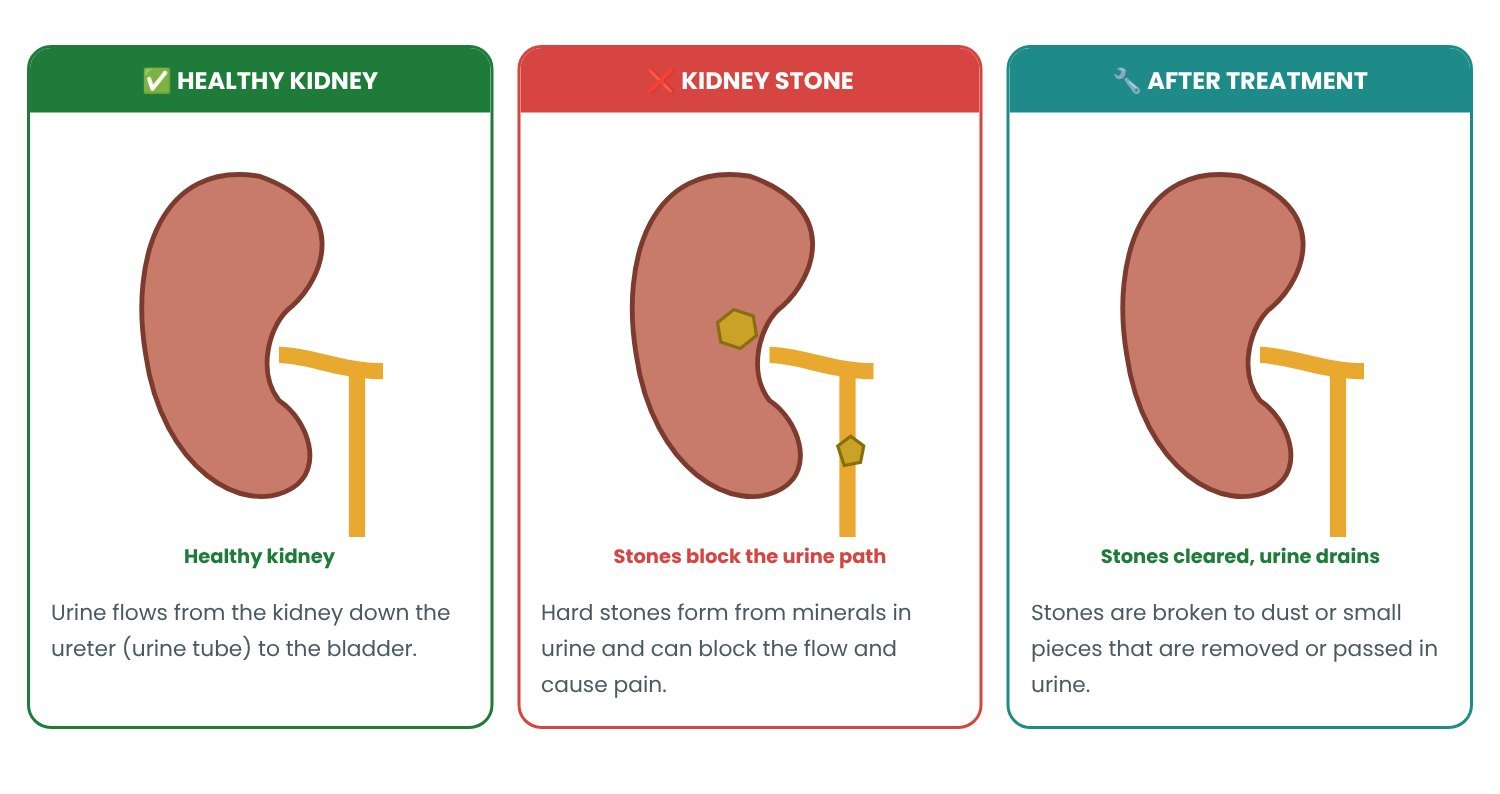
A kidney stone (renal calculus) is a hard deposit formed when minerals and salts in the urine become concentrated and crystallise. Stones can stay in the kidney or move down into the ureter (the tube that carries urine to the bladder), where they can cause blockage and pain. They range in size from a grain of sand to several centimetres; large branching stones that fill the kidney are called staghorn stones.
Types of kidney stones
- Calcium oxalate stones - the most common type, linked to low fluid intake, high salt and high oxalate diets.
- Calcium phosphate stones - associated with certain metabolic conditions such as renal tubular acidosis.
- Uric acid stones - more common in people with gout, diabetes, obesity or a diet high in red meat; they are also common in hot climates where urine is concentrated and acidic.
- Struvite (infection) stones - form after repeated urinary infections and can grow quickly into staghorn stones.
- Cystine stones - rare, caused by an inherited disorder (cystinuria), more frequent in some communities where marriages between relatives are common.
🖼️ Understand It in Pictures
Healthy kidney vs kidney stone, and after RIRS
👀 Symptoms in Pictures
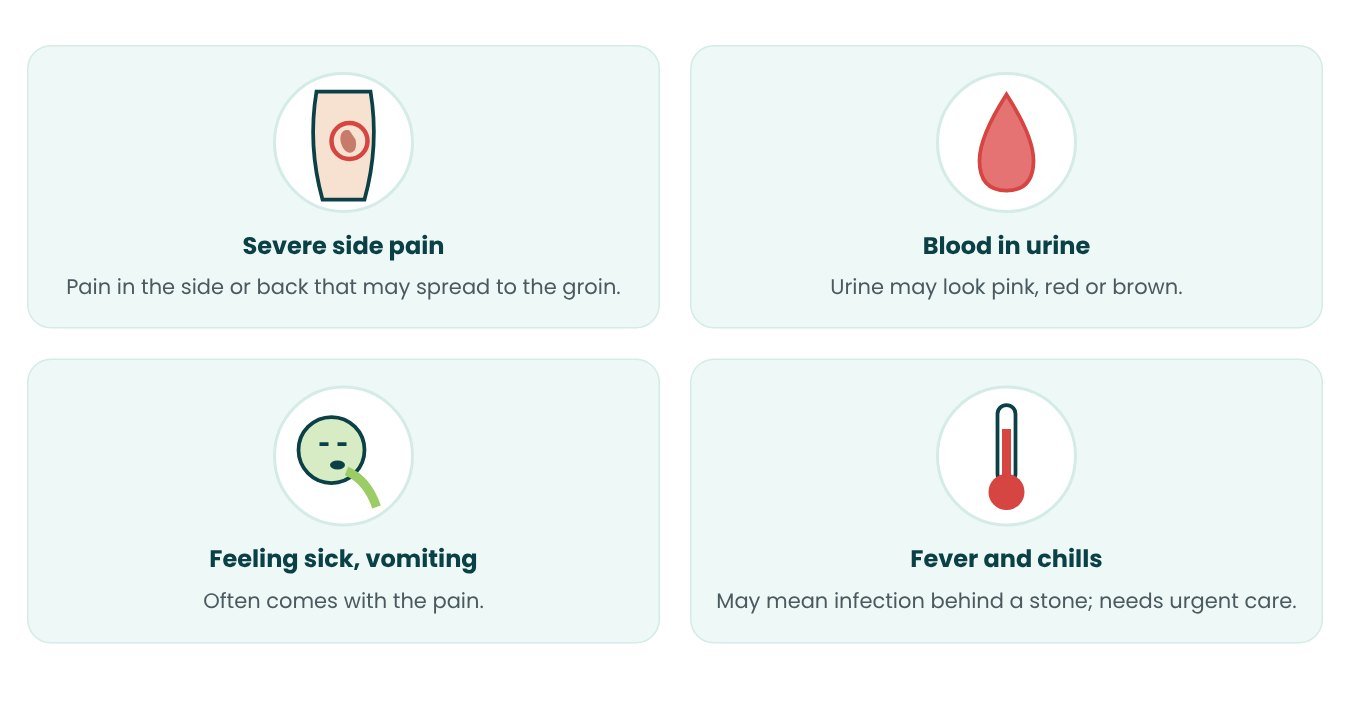
🩻 Scans & Tests — What Doctors See

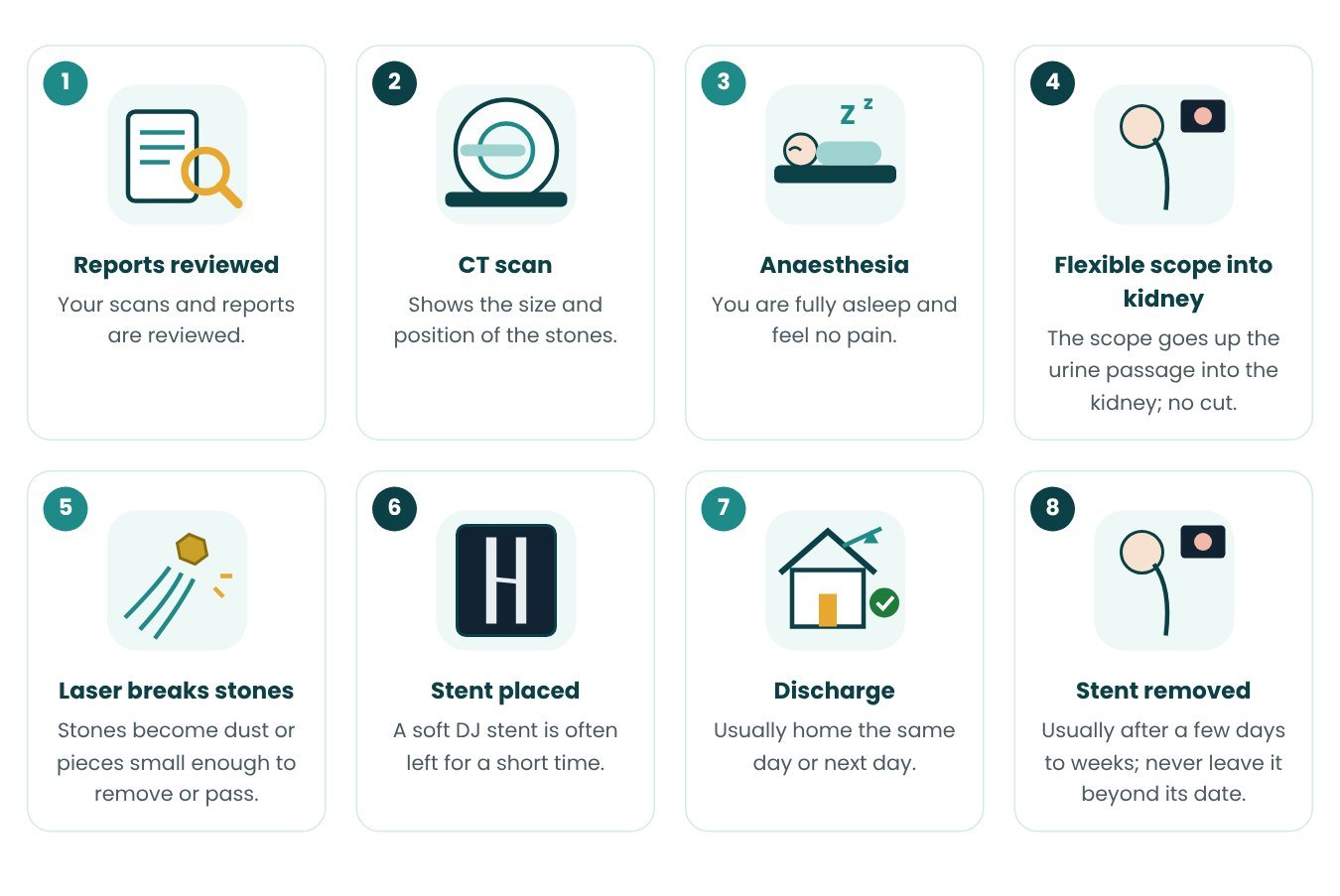
🎬 The Treatment Journey in Pictures
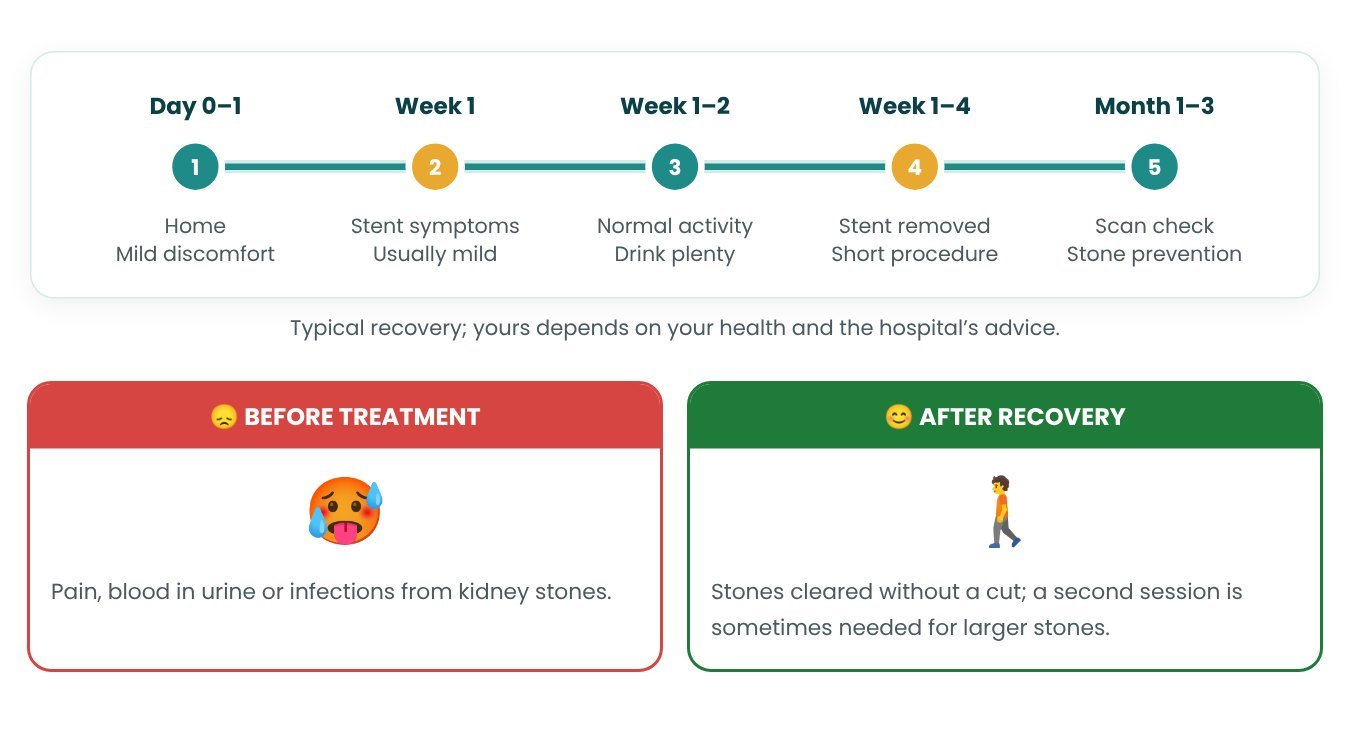
📅 Recovery at a Glance
Drawings: Satyug Healthcare (simplified, not to scale). Photos: Wikimedia Commons; author and licence under each photo.
Causes and Risk Factors
- Dehydration - the single most important factor. Living or working in hot climates, as in the Gulf, North Africa and India, greatly increases risk.
- Diet - high intake of salt, animal protein, sugar-sweetened drinks and oxalate-rich foods.
- Obesity, diabetes and metabolic syndrome.
- Family history of kidney stones.
- Medical conditions such as hyperparathyroidism, gout, inflammatory bowel disease and repeated urinary tract infections.
- Anatomical problems such as a narrowing at the junction of the kidney and ureter (PUJ obstruction) or horseshoe kidney.
- Certain medicines and supplements, including excess vitamin C or calcium supplements in some people.
Symptoms of Kidney Stones
Small stones in the kidney may cause no symptoms and are often found on a routine scan. When a stone moves, it can cause:
- Severe, sharp pain in the side and back, below the ribs, that may spread to the lower abdomen or groin (renal colic)
- Pain that comes in waves and changes in intensity
- Blood in the urine (pink, red or brown urine)
- Nausea and vomiting
- Burning while passing urine, frequent urge to urinate, or passing small amounts
- Cloudy or foul-smelling urine
Seek urgent medical care if you have: fever and chills with stone pain (a sign of infection behind a blocked kidney, which is an emergency), pain so severe you cannot sit still or find a comfortable position, persistent vomiting, or no urine output. A stone in a single (solitary) kidney or in both kidneys also needs urgent attention.
How are Kidney Stones Diagnosed?
- Non-contrast CT scan (CT KUB) - the most accurate test to find the size, number and location of stones.
- Ultrasound - a safe first test, especially for pregnant women and children.
- X-ray KUB - helpful for follow-up of stones that are visible on X-ray.
- Urine tests - to look for blood, infection and crystals; a urine culture before any procedure.
- Blood tests - kidney function (creatinine), calcium, uric acid and, in recurrent cases, parathyroid hormone.
- Stone analysis and 24-hour urine test - to find out why stones form and prevent new ones.
Treatment Options for Kidney Stones
1. Watchful waiting and medical expulsive therapy
Many stones smaller than about 5 mm pass on their own within a few weeks. Doctors may prescribe pain relief, plenty of fluids and medicines such as tamsulosin that relax the ureter and help the stone pass. Uric acid stones can sometimes be dissolved with medicines that make the urine less acidic.
2. Extracorporeal Shock Wave Lithotripsy (ESWL)
Shock waves are focused on the stone from outside the body to break it into small pieces that are then passed in the urine. It needs no incision and is usually a day-care procedure. ESWL works best for smaller stones in the kidney or upper ureter and is less effective for very hard stones or stones in the lower part of the kidney.
3. Ureteroscopy (URS) with laser lithotripsy
A thin telescope is passed through the urethra and bladder into the ureter. The stone is broken with a holmium or thulium laser and fragments are removed. A temporary stent (DJ stent) is often placed and removed after a few weeks.
4. Retrograde Intrarenal Surgery (RIRS)
RIRS uses a flexible ureteroscope that can bend to reach every part of the kidney through the natural urinary passage. Stones are dusted with laser energy. There is no cut on the skin, and most patients go home within 24 to 48 hours. RIRS is a good option for kidney stones up to about 2 cm, for patients on blood thinners, and for those with obesity or kidney anatomy that makes other approaches difficult.
5. Percutaneous Nephrolithotomy (PCNL)
For large stones (generally more than 2 cm) and staghorn stones, the surgeon makes a small opening in the back and passes a scope directly into the kidney to break and remove the stone. Mini-PCNL and ultra-mini PCNL use smaller instruments, reducing bleeding and hospital stay.
6. Laparoscopic or robotic surgery
Rarely needed today, this is used for very large stones together with an anatomical problem that needs repair at the same time, such as PUJ obstruction.
Cost of Kidney Stone Treatment in India
Indicative starting prices at leading JCI/NABH accredited hospitals in Delhi NCR:
| Treatment | Starting cost (USD) |
|---|---|
| Urology consultation with CT KUB and blood tests | From $200 |
| ESWL (shock wave lithotripsy) | From $800 |
| Ureteroscopy (URS) with laser lithotripsy | From $1,800 |
| RIRS (flexible laser kidney stone removal) | From $2,500 |
| PCNL / Mini-PCNL | From $2,800 |
| Laparoscopic pyelolithotomy | From $3,500 |
Note: these are starting estimates. The final cost depends on stone size and number, whether one or both kidneys are treated, the technology used, the hospital chosen and the length of stay.
Contact Satyug Healthcare at +91-8860606766 / +91-9910655125 (WhatsApp) for a free medical opinion and cost estimate.
Recovery and Prevention
After ESWL, URS or RIRS, most people return to normal activities within a few days. After PCNL, light activity is possible in about a week. If a DJ stent has been placed, you may feel some discomfort or notice blood in the urine until it is removed. International patients can usually fly home 3 to 7 days after the procedure, depending on the type of treatment and the stent plan.
About half of people who have had one stone will develop another within several years, so prevention is very important:
- Drink enough fluid to pass at least 2 to 2.5 litres of urine a day - more in hot climates or during Ramadan non-fasting hours.
- Add lemon or other citrus to water; citrate helps prevent calcium stones.
- Reduce salt, processed foods and excess animal protein.
- Do not cut out dietary calcium unless your doctor advises it; normal calcium intake with meals actually helps prevent oxalate stones.
- Limit sugary soft drinks and high-oxalate foods such as spinach and nuts if you form oxalate stones.
- Maintain a healthy weight and control diabetes.
- Have a yearly ultrasound or X-ray if you are a recurrent stone former.
Why Choose India for Kidney Stone Treatment?
- Highly experienced urologists performing large volumes of RIRS, mini-PCNL and laser procedures.
- Latest holmium and thulium fibre lasers and flexible digital ureteroscopes at major hospitals.
- Significant savings compared with the USA, UK and Gulf countries.
- Short hospital stays, no waiting lists and quick return home.
Step-by-Step Process to Travel to India for Treatment
- Share your reports - send your latest reports, scans/CD, angiography or echo films and passport copy to Satyug Healthcare on WhatsApp (+91-8860606766 / +91-9910655125) or email.
- Free medical opinion & cost estimate - within 24-72 hours we share opinions and written cost estimates from 2-3 JCI/NABH-accredited hospitals and specialists.
- Choose hospital & doctor - compare doctor experience, hospital, room category and total cost; we help you decide with no extra charge.
- Visa Invitation Letter (VIL) - the hospital issues a VIL for the patient and up to two attendants; we arrange it within 24-48 hours.
- Apply for Indian e-Medical Visa - apply online for the e-Medical Visa (patient) and e-Medical Attendant Visa (family) using the VIL; most approvals come in 3-5 working days.
- Book flights & accommodation - we suggest flights and arrange a guest house, service apartment or hotel near the hospital to suit your budget.
- Free airport pickup - our representative receives you at the airport and takes you to your hotel or directly to the hospital.
- Hospital admission & treatment - a dedicated coordinator and language interpreter stay with you for registration, tests, doctor consultations, the procedure and billing.
- Discharge & follow-up - you receive the discharge summary, prescriptions and fitness-to-fly certificate; follow-up checks are done before you fly.
- Return home & tele-follow-up - we arrange airport drop and stay connected for online follow-up consultations with your doctor in India.
Frequently Asked Questions
What size of kidney stone can pass naturally?
Stones smaller than about 5 mm often pass on their own with fluids and medicines. Stones between 5 and 10 mm may pass but often need treatment, and stones larger than 10 mm rarely pass without a procedure.
Which is better, RIRS or PCNL?
It depends on the stone. RIRS is usually preferred for stones up to about 2 cm because it needs no cut, while PCNL is generally more effective for stones larger than 2 cm and staghorn stones. Your urologist will advise after reviewing your CT scan.
Is laser kidney stone surgery painful?
The procedure is done under general or spinal anaesthesia, so you will not feel pain during it. Afterwards there may be mild discomfort, burning while urinating or stent-related discomfort, which is controlled with medicines.
How long will I stay in India for kidney stone treatment?
For ESWL, URS or RIRS, a stay of about 5 to 7 days is usually enough. For PCNL, plan for about 7 to 10 days. If a stent needs removal, it can sometimes be removed before you fly or later in your home country.
Can kidney stones damage the kidney?
Yes. A stone that blocks urine flow for a long time, or causes repeated infections, can permanently damage the kidney. This is why blocked kidneys and infected stones should be treated promptly.
Do kidney stones come back after treatment?
They can. Stone analysis and metabolic testing help identify the cause, and following a prevention plan with adequate fluid intake greatly reduces the chance of recurrence.
Is RIRS safe for patients with diabetes or heart disease?
Generally yes, after a pre-operative check-up. RIRS is often chosen for patients who cannot safely stop blood thinners, because it carries a low bleeding risk.
Disclaimer: This article is for general information only and is not a substitute for a consultation with a qualified doctor.
Related Blogs



HAPPY PATIENTS
What Our Patients Are Saying




























Our Gallery